
2026 Judicial Demographics Report: California Bench Continues to Grow More Diverse
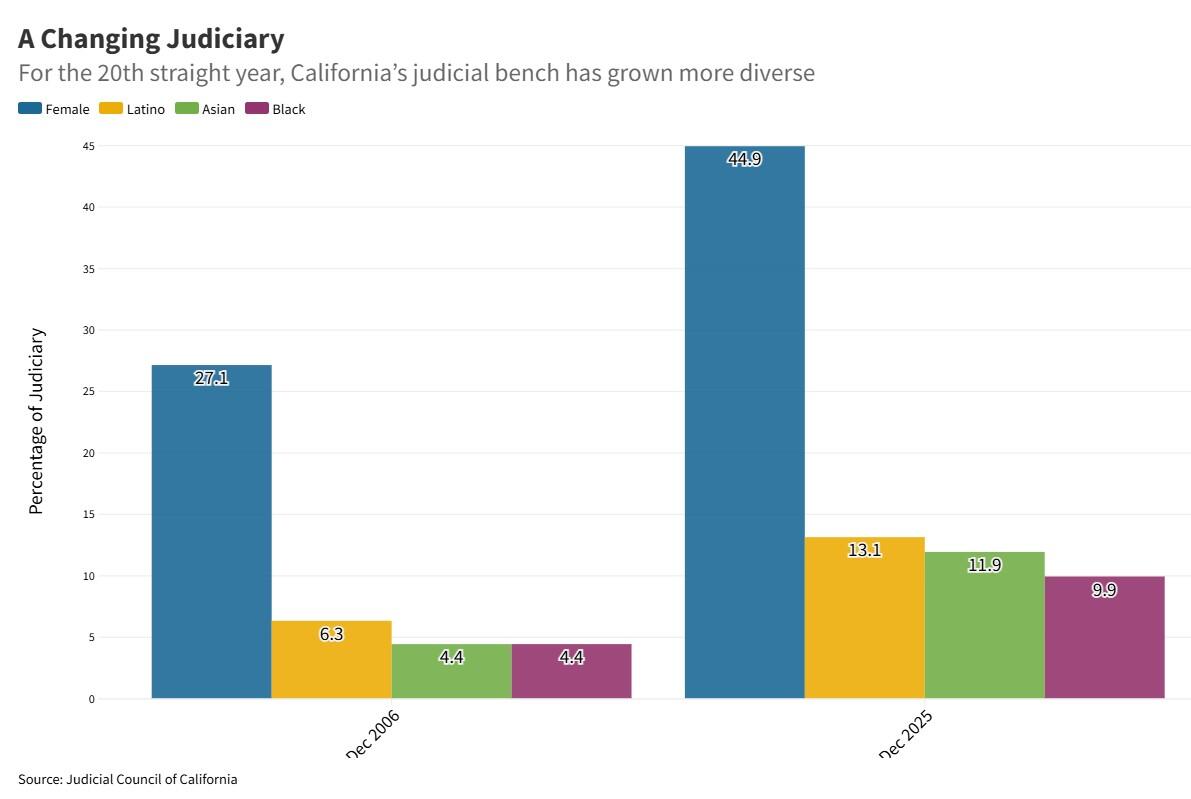
Since December 2006:
- Number of female justices and judges is up 17.8 percentage points
- Percentage of Asian, Black, and Hispanic justices and judges has increased more than 140 percent
For the 20th straight year, California’s judicial bench has grown more diverse, according to the Judicial Officer (JO) Demographic Data report released by the Judicial Council.
The data reflect demographic information self-reported by justices and judges on the bench as of December 31, 2025, with a response rate of 93%. Responding to the questionnaire is voluntary, and the data only reflects the responses provided.
Per data collected in December 2025 (and published in March 2026), responding female justices and judges constitute 44.9% of the judiciary across all court levels, a 1.6 percentage point increase over the prior year and an increase of 17.8 percentage points since December 2006—the first time that data were collected for this purpose.
The bench also has continued to become more racially and ethnically diverse. The percentage of responding Asian, Black, and Hispanic justices and judges has increased by more than 140 percent since 2006.
Statewide, Multi-Branch Effort to Increase Judicial Diversity
The Judicial Council’s Strategic Plan for California’s Judicial Branch makes explicit the branch’s commitment to a diverse and inclusive court system. The plan supports efforts like the council’s Pathways to Judicial Diversity toolkit, which encourages courts to reach out to underrepresented groups—including individuals with diverse racial and ethnic backgrounds, disabilities, and sexual orientations—to educate and advise them about pursuing careers in the law.
In addition, the Judicial Mentor Program is a statewide undertaking between the Governor’s office and the California courts to develop and recruit qualified and diverse judicial applicants—and the state’s appellate and superior courts also have their own local mentor programs.
Progress on increasing judicial diversity has continued under our current Governor’s appointments. Since taking office in 2019 through 2025, more than half of Governor Gavin Newsom's 695 judicial appointments have been women justices and judges, and more than half also identified as Asian, Black or African American, Hispanic, or Native Hawaiian or other Pacific Islander.

Survey of California Bench
The Judicial Council surveyed California judges and justices in December 2025 to get a snapshot of the demographics of the California bench—including gender, race/ethnicity, and sexual orientation.
Among the findings:
Gender
Of the responding judicial officers, data show the percentage of female justices and judges has increased to 44.9%, compared to 27.1% in 2006, continuing a steady upward trend.
Race and Ethnicity
The data also show changes over the past 20 years in the percentage of responding justices and judges reported in the following race/ethnicity categories:
- American Indian or Alaska Native (0.3% in 2025 compared to 0.1% in 2006)
- Asian (11.9% in 2025 compared to 4.4% in 2006)
- Black or African American (9.9% in 2025 compared to 4.4% in 2006)
- Hispanic or Latino (13.1% in 2025 compared to 6.3% in 2006)
- Pacific Islander (0.2% in 2025 compared to 0.1% in 2006)
- White (55.8% in 2025 compared to 70.1% in 2006)
- Some Other Race (1.4% in 2025 compared to 0.2% in 2006)
- More Than One Race (5.8% in 2025 compared to 4.4% in 2006)
- Information Not Provided (1.5% in 2024 compared to 9.9% in 2006)
These changes reflect judicial retirements and other departures from the bench, new judicial appointments, and an increase in the number of trial court judges who voluntarily provided race/ethnicity information.
Gender Identity/Sexual Orientation
This is the 15th year that the study includes data on gender identity and sexual orientation, as required by a law passed in 2011. Survey respondents reported the following:
- Heterosexual – 80.9%
- Lesbian – 2.1%
- Gay – 3.0%
- Bisexual - 0.7%
- Transgender - 0.12%
- Nonbinary – 0.06%
- More than One Gender ID/Sexual Orientation – 0.3%
- Information not provided – 12.9%
Veteran and Disability Status
In addition, this is the 12th year that the study includes data on veteran and disability status. These questions were first asked of justices and judges who were new to the bench during the 2014 calendar year, although judges appointed before this date are free to update this aspect of their demographic profile as well.
Of the 1170 active justices and judges responding to the question about their status as a veteran, 70 respondents (5.9%) indicated they have served in the military. Of the 1177 active justices and judges responding to the question concerning their disability status, 40 justices and judges (3.3%) indicated they have a disability.
About Judicial Officer Demographic Data
Government Code section 12011.5(n) requires the Judicial Council to collect and release aggregate demographic data on California state justices and judges by March 1 every year. This is the report’s 20th year.
Increasing the diversity of California’s justices and judges to reflect California’s populace continues to be a goal of the Judicial Council.