Research & Data

Court Operational Metrics

Data updated January 2025

Overview

Every year, California’s county-level trial courts handle millions of cases that affect families, communities, and public safety. Senate Bill 154 (2022) requires the Judicial Council to publicly report annually on trial court operations, including filings, staffing, backlogs, case resolution timelines, and workload.

Why does this matter?

Court operational metrics offer a view into how justice is being served in California, including insight on the filings trends of different types of cases, how long they take to resolve, and their demand on court resources. They support everyone—from the public to policymakers—in understanding the function of the largest court system in the United States. 

Statewide Case Trends 

Explore statewide trends for specific case types. See how filings, time to disposition, and clearance rates vary over time and across different types of cases1.

Case Workload

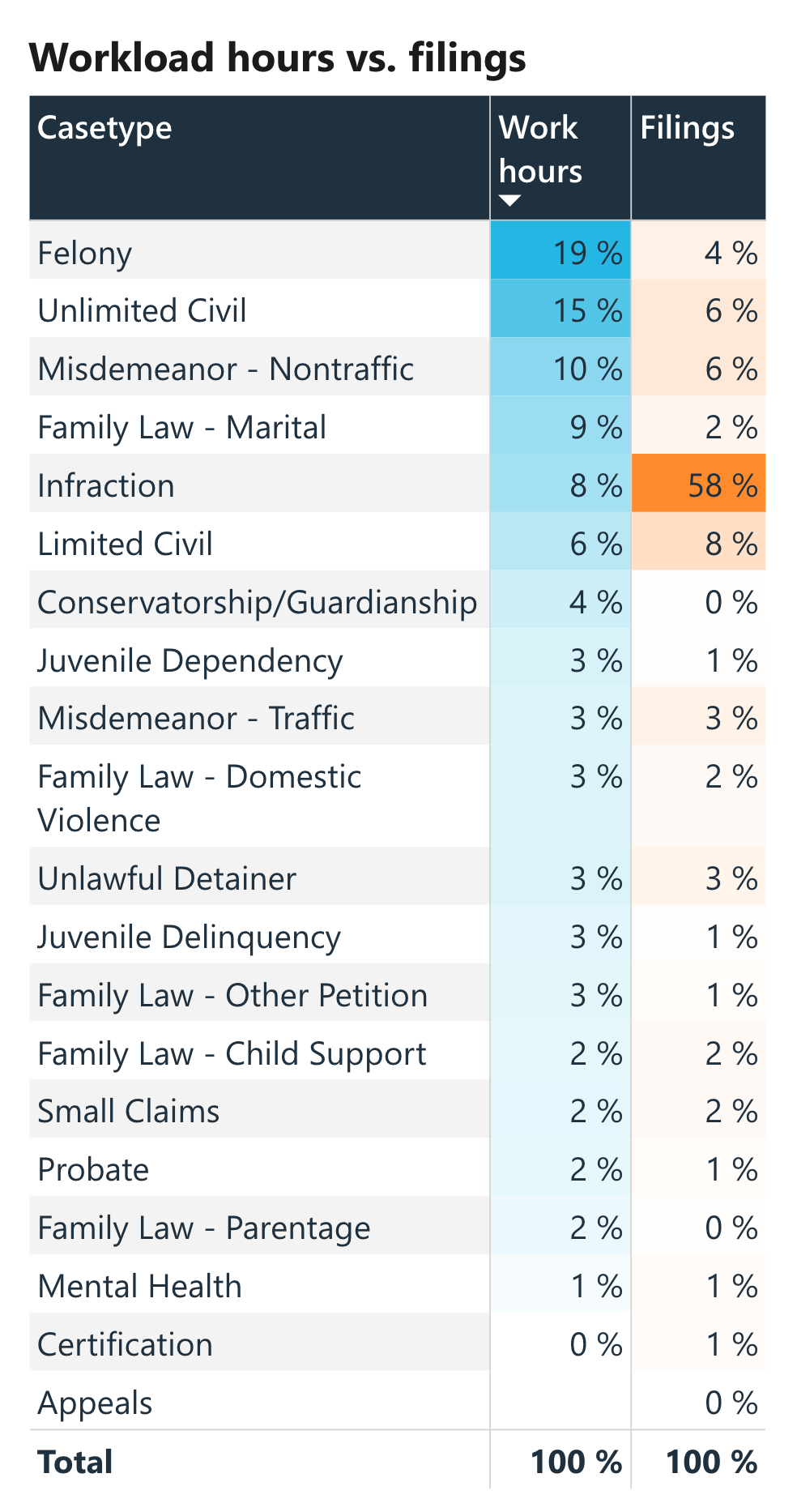
This chart offers a fuller view of how court resources are distributed across case types. Compare each case type's share of total filings against the share of the courts' staff time it takes to process them. The Judicial Council uses weighted caseload assessments to measure the number of judges and other resources needed in each court.

Some case types — such as felony — represent a relatively small share of filings but a large share of workload. Conversely, other case types — like infractions — make up a very large share of filings but a small share of overall workload. 

Table showing the percent of work hours spent on each case type versus the share of filings of each case type. Work hours and filings do not correlate by case type.

This chart utilizes case weights developed in the 2024 Resource Assessment Study and Judicial Workload Study. The case weights are inclusive of pre and post-disposition work. Learn more about how we assess court workload.

Court Profiles

Select a court to view judicial staffing, filing trends, and case resolution data. This profile offers a snapshot of local court operations and how they compare to broader state patterns.

Time to disposition

Time to disposition is the number of days or months it takes for a case to be disposed after it is filed.

For each available case type, see what percentage of cases are disposed within various timeframes.

Notes

1Statewide case type clearance rates presented in the Statewide Case Trends visual differ from the clearance rates reported in the Court Statistics Report. The clearance rate calculation in the dashboard excludes counties that do not report disposition from the statewide clearance rate calculation