
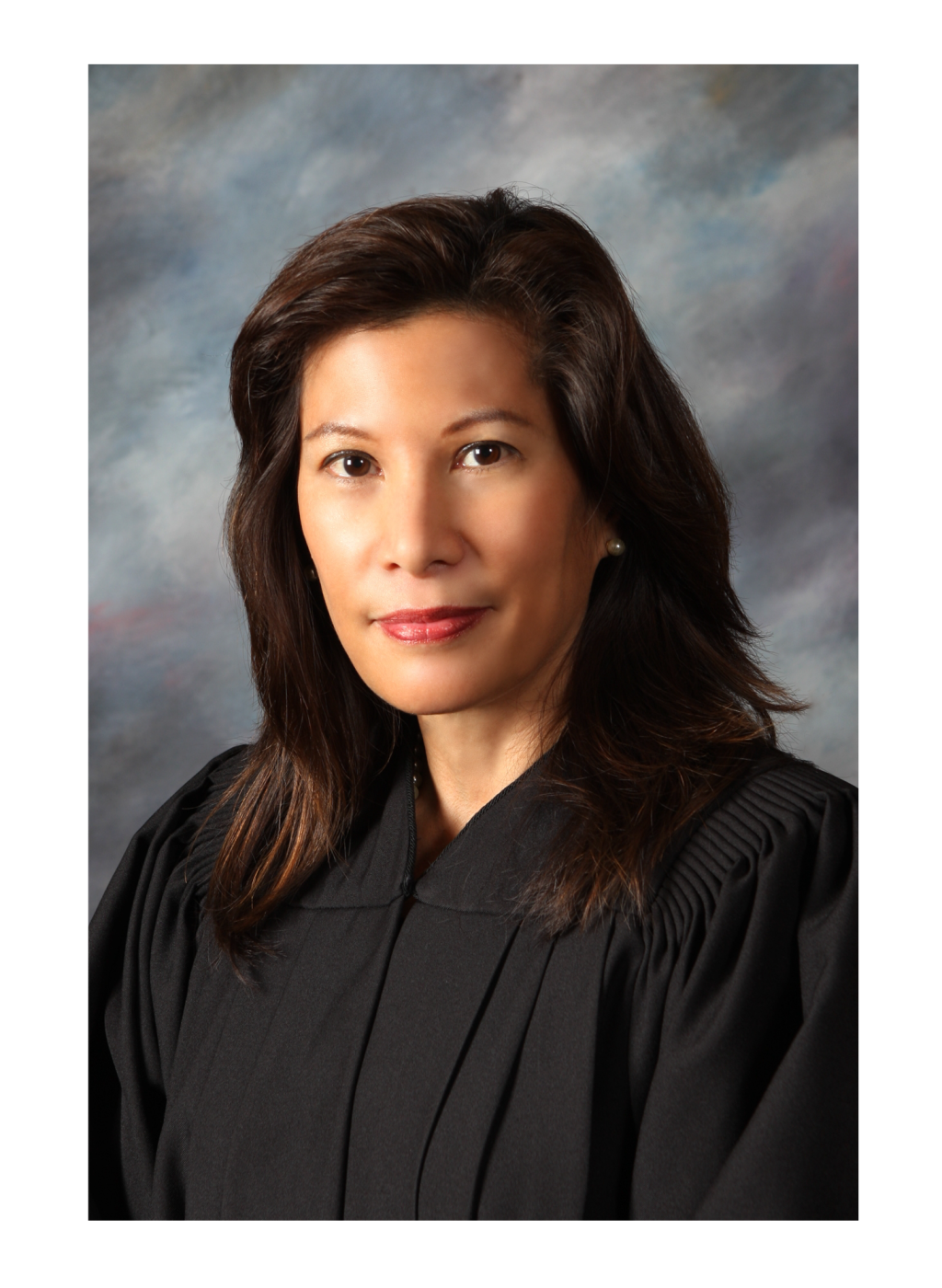
Former Chief Justice Cantil-Sakauye shares her thoughts on the successes and challenges of her tenure as part of the 100-year history of the Judicial Council.
Q: Good afternoon, Chief Justice Tani Cantil-Sakauye. Thank you for taking time from your busy schedule as the head of the Public Policy Institute of California to
share your leadership reflections. I’m curious: As you look back on your tenure as Chief Justice and Chair of the Judicial Council, what do you wish you knew before you took on this task?
Chief Justice Cantil-Sakauye: Thank you for that question. It’s hard to say because I think that having and confronting a crisis in the moment really brings out our best instincts about how to deal with it, how to include folks, and how to proceed. So, I can’t say for certain that there’s anything I wish I concretely knew ahead of time. But I wish I had known more, a little bit more, about how the judicial branch was perceived in the grand scheme of democracy in California.
I think I just assumed that people understood all three branches of government, and that there would be easier conversations about making sure that all of the government could still provide services during a time of crisis, like the Great Recession, or COVID-19, or budget issues. I wish I’d known a little bit more about how external third parties really perceive the judiciary and its role.
Q: So, what did you know about the Judicial Council as an attorney or a judge?
Chief Justice Cantil-Sakauye: As an attorney, I didn’t hear anything about the Judicial Council, when I should have known that it was the body responsible for the jury instructions that I was curating to give to a judge for a trial. I should have known that the council was so integral to developing California Rules of Court. But as an attorney, I didn’t have any of that education. And then when I became a judge in the 1990s, all I heard was how people didn’t know a lot about what the Judicial Council was doing. I did know of them before the unification of municipal and superior courts, but the council in the 1990s was a smaller organization, and it didn’t have a strong presence in the Sacramento superior court where I served.
Q: What do you wish the public would know about the Judicial Council?
Chief Justice Cantil-Sakauye: I wish the public would understand that the judiciary is not just a collection of courts operating willy-nilly and freewheeling, that it is a branch of government, and that the Judicial Council is the tether, is the board of directors, is the policymaking body for the judiciary. I wish the public knew how much the Judicial Council is engaged in deliberative policy, research, and advocacy. And how for the public, the Judicial Council is a place for solutions and for their local courts to understand this is where solutions exist. I wish that more of the public knew what a strong, deliberative, and effective body the Judicial Council is for the judicial branch.
Q: Narrowing the focus a bit, what do you wish that attorneys would know, and judges would know about the council?
Chief Justice Cantil-Sakauye: For attorneys and judges, I wish they knew that the Judicial Council’s strength and its effectiveness come from the volunteers who give their time to serve on the council’s advisory bodies—for judges who have, like the attorneys, full-time day jobs but who also give more of their time, free of charge, to ensure that the third branch of government can operate as a coequal of the other two branches. I wish that more attorneys and judges knew how vital their knowledge and active participation is to the Judicial Council and to ensuring that there is access to justice for all.
Q: And would that be the same for court staff as well, or are they in a different kind of group?
Chief Justice Cantil-Sakauye: No, I think those answers apply to court staff, but I wish too that court staff understood that we rely on their knowledge and their experience and their challenges in what they see every day in court in order to craft the kind of important policy that the Judicial Council will adopt. I wish court staff knew how essential they are to informing the council about how things really work, and how things should work. Court staff participation is as important as attorney participation and judicial participation because they are the “boots on the ground.”
Q: That feeds nicely into my next question. What roles do judicial officers, court administrators, and court staff have with the Judicial Council?
Chief Justice Cantil-Sakauye: The reason we need their involvement is because California is such a diverse and large state, with so many different cultures within the 58 counties where courts operate, and because we are trying to follow and abide by the same rules and statutes and local rules, it’s important for us to know how Butte operates, how Inyo operates, how LA operates, with the understanding that no one court does it best.
Q: What were your biggest administrative challenges as Chair of the Judicial Council?
Chief Justice Cantil-Sakauye: Well, I think that the challenges that I faced were contextual and relevant to the time period when I became Chief Justice in 2011, and I inherited, I think, a branch that had already been experiencing the awful effects of the Great Recession and the reductions in resources to operate and be able to compensate employees and provide services. So, I came in at that time with more work to do to reduce costs, and I feel like I inherited a disconsolate judiciary—judges and attorneys who were not aware of why or how the judiciary was operating but had a feeling that it wasn’t operating at its best. Also, I think I took over at a time when the Legislature was in its own throes of angst with trying to balance a budget, trying to find a dollar, and so when I came to the capital seeking funding, there weren’t open arms, and, understandably, it was a time where people were basically operating out of some gut instinct about self-preservation.
That was a huge challenge, so the first thing I did was to survey judges and have them write to me about where they thought the branch needed improvement. I received a lot of feedback, which led me to create a commission of judges and lawyers—retired and current—as well as court administrators to assess ourselves.
So, I started our self-evaluation, which came back with a set of recommendations. We pursued the recommendations and eventually were able to, I think, turn around some of the hearts and minds about what we were trying to do with the judiciary in a time of crisis with the Great Recession.
This was also going on during a time of layoffs, court closures, and desk court clerk window closures, and people going without raises for years and years, and so it was not the best of times to be asking these questions, but we learned. I think we earned trust, and that made a difference in going forward to try to tackle other problems.
Q: When you talked about the other branches of government and having to deal with them, how did you navigate that? You came to a relatively hostile Legislature and, as you said, they were focused on their own issues, and so was the executive branch.
Chief Justice Cantil-Sakauye: I realized that the Legislature lacked understanding of what we were doing and why we were doing it, and that if I could speak to them individually and then collectively and try to assist them in whatever task or proposal they had that didn’t interfere with my ethical duties as the Chief Justice, I would. Because I felt they needed to know us better and understand what we were doing for the justice system. They make the law, we clarify it, we interpret it, and so it really meant that whole cliche of really building relationships, one meeting, one coffee, one breakfast at a time. I flew down to legislators’ districts and participated in these crack-of-dawn town halls with them, just trying to answer their constituents’ legal questions about the court system. I attended events, we supported one another. It was about proving that we were all in this together. I wanted them to understand why I was there, and always asking for branch support and resources, and that we had to go forward together.
Q: What are the three things that you are most proud of in your role as Chair of the Judicial Council?
Chief Justice Cantil-Sakauye: I will say the ‘lasting heart’ part of me and what I’m most proud of about the Judicial Council is the members and staff I worked with—high-quality, smart people who gave themselves to public service. I feel like it was a magical moment for me to be with everyone, and I’m so proud of how we all came together to think about what’s best for access, what’s best for justice, and then we all trusted each other to be in our lane to achieve that collectively. As a result, for example, we strengthened positive working relationships with our courts and court administrators, with the Legislature, and with the media.
I also think what I’m proud of is that at the Judicial Council, all of our members, over time, over the 12 years, I felt always spoke their truth. We fostered an environment where people could disagree, we could reconsider, we could plow ahead, we took advice from everyone, we heard from everyone, and I think when people joined committees and joined the Judicial Council, they were surprised about how we operated in such a, I want to say, a safe environment, and I’m proud of that.
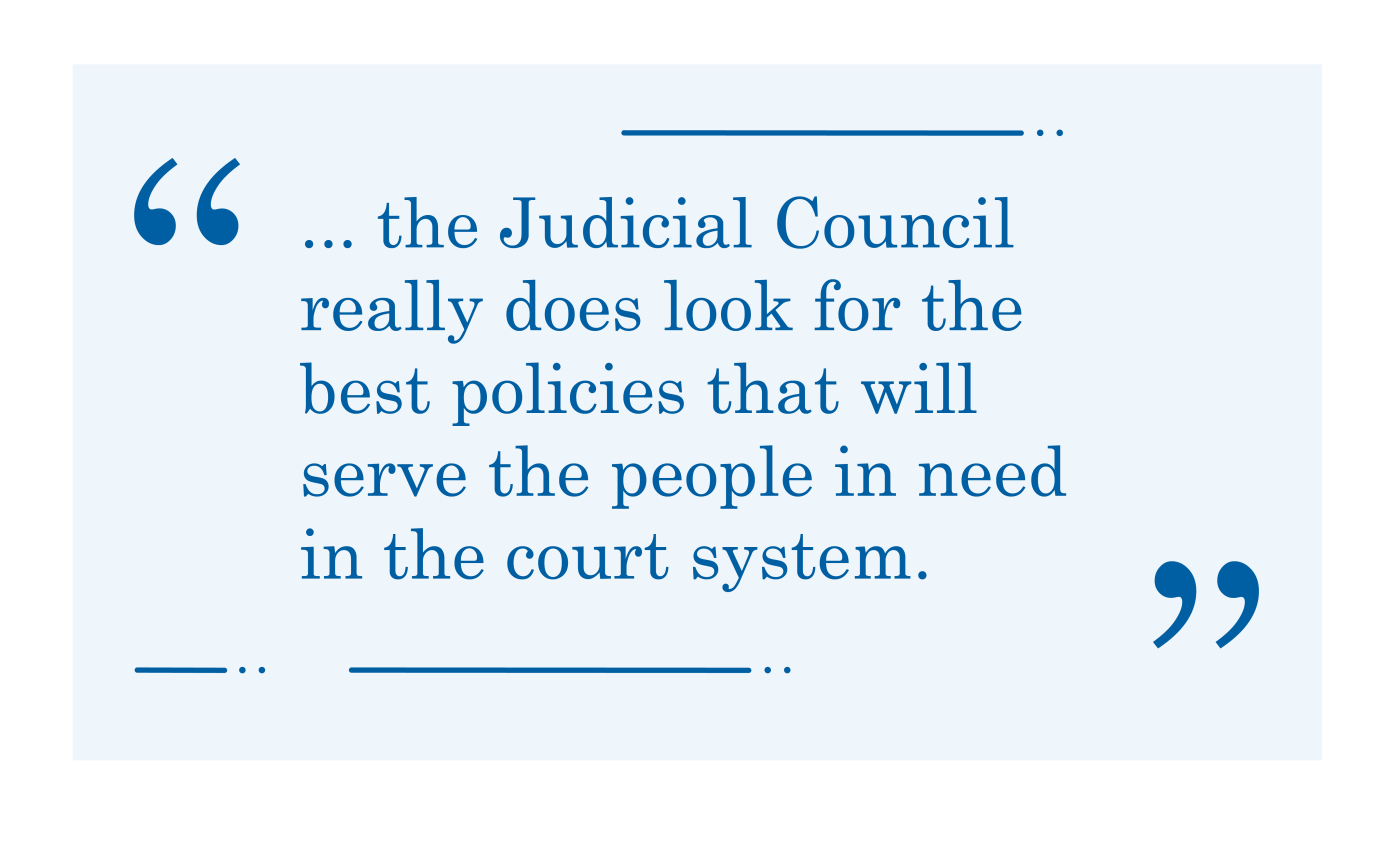
And I’m proud of all the accomplishments of the Judicial Council in our 12 years together. The things that we pursued were on behalf of the people and their treatment in court, their access to court, their sentences, their restitution, and their fines. I feel like the Judicial Council really does look for the best policies that will serve the people in need in the court system.
Q: On the 100-year anniversary of the Judicial Council, what message do you have for council members and staff?
Chief Justice Cantil-Sakauye: To staff, I want to say thank you, because I think you are the most underappreciated and unknown group in all the judiciary, and that without the Judicial Council staff and your expertise, we would not have the reputation that we have in California for our judiciary. And so, I remember all of our public service anniversary events that we used to get together for every year, and we would celebrate and take pictures with staff who had reached service milestones. And we would present service pins, and that was one of the best experiences I ever had, to see you all in person. And if people could only know about your dedication, they would know that there is magic there. So, to all of you, I say a deep and grateful thank you. There is no other excellence like yours. And to the Judicial Council members—it all matters, and I thank you for giving of your time, because it couldn’t be done without you, and I know what a heavy lift Judicial Council membership is, so thank you!