
Reducing Fines & Fees for California’s Defendants
Data updated December 2025
Overview
Traffic fines and fees in California are the same regardless of income—and for people already struggling financially, an unexpected ticket can mean choosing between paying court debt and paying rent. MyCitations is a free online tool from the California courts that allows defendants to request a reduction in what they owe without ever stepping into a courtroom.
Available in all 58 superior courts statewide, by the end of 2025 MyCitations has processed over 470,000 requests since 2019, helping over 340,000 defendants seek relief from court-ordered debt. Courts have reduced unpaid fines and fees by more than $115 million through the program—and the data has shown that when people receive a reduction, they’re more likely to pay.
Summary of Findings
Explore the data below to see how MyCitations requests continue to increase and provide debt relief to lower-income California defendants.
MyCitations improves access to relief
California’s fines and fees structure has evolved dramatically over the past 20 years. This structure is comprised of multiple categories including fines, fees, surcharges, penalties, assessments, and restitution. This structure can vary by violation (as not all categories apply to all violations) and county (as courts and counties have discretion over penalties and assessments). It can result in total violation costs that are complex, lacking in transparency, and economically burdensome.
Prior to the implementation of MyCitations, relief from high fines and fees could only be accessed by visiting the court in-person or submitting paper forms. In 2016, a pilot program was established to facilitate online filing of ability to pay requests, and in 2019 the first court went live on MyCitations. In 2021 Assembly Bill 143 allocated funding for MyCitations to be expanded statewide, increasing access to relief to all 58 California trial courts and expediating processing for the courts.
Since statewide expansion of the program concluded in July 2024, the volume of ability to pay requests has increased. In total, over 470,000 requests have been submitted through the end of 2025.
When submitting an ability to pay request for a reduction in MyCitations, defendants may request additional relief with a payment plan, more time to pay, and community service. Over 87 percent of the requests submitted were granted at least one of the four types of possible relief. The average processing time is under two weeks, and judicial orders are served via email.
From 2019 through 2025, more than 340,000 defendants utilized MyCitations to request relief from infraction fines and fees.
Defendants experiencing financial hardship are using MyCitations for eligible California infraction violations.
MyCitations is reaching the people it was designed to help. Eligibility for a reduction is based on a person’s income level and whether they receive public benefits like Medi-Cal, CalFresh, and CalWORKs.
The federal poverty level, a national income measure guideline that includes household size, is used to assess eligibility when a defendant is not on benefits, with California’s higher cost of living providing important context. For instance, in 2025 a family of four earning $40,188 annually was considered as living at 125% of the federal poverty level, according to the Federal Department of Health and Human Services.1 Income of 125% or less of the current poverty guidelines is one of the factors a court must consider, as indicated in Government Code Section 68645.2.2 However, the high cost of living attributed to California counties means people living well above the federal poverty level still experience financial hardship, especially when faced with the unforeseen expenses associated with infraction violations.
Since 2019, just over 49 percent of requests made in MyCitations came from defendants who reported receiving public benefits, and 62 percent of requests came from defendants who reported household incomes at or below 125 percent of the federal poverty level. These proportions are consistent year after year, suggesting the tool continues to reach defendants experiencing financial hardship.
Courts have reduced more than $115 million dollars in unpaid infraction debt through MyCitations since 2019.
Courts are granting reductions and payment plans at high rates
When defendants ask for help through MyCitations, courts are providing relief. Through 2025, nearly 79% of all requests were approved for a reduction, and just over 87% of all requests received at least one form of relief—whether a lower amount, a payment plan, more time to pay, or community service.
Defendants can also request a payment plan, more time to pay, or community service as part of their submission. The most common outcome is a reduction paired with a payment plan.
Since the beginning of the program, defendants have requested relief for over $215 million dollars of fines and fees from eligible infraction violations. Courts reduced more than $115 million—lowering the average amount owed from $499 to $233 per case.
Payment rates improve when fines and fees are adjusted
Reducing what defendants owe, after considering their ability to pay, means fines are more likely to be fully paid, easing the burden of outstanding debt. The JCC performed an analysis of nearly 26,000 MyCitations cases processed during the prior fiscal year in the 2025 Report to the Legislature.
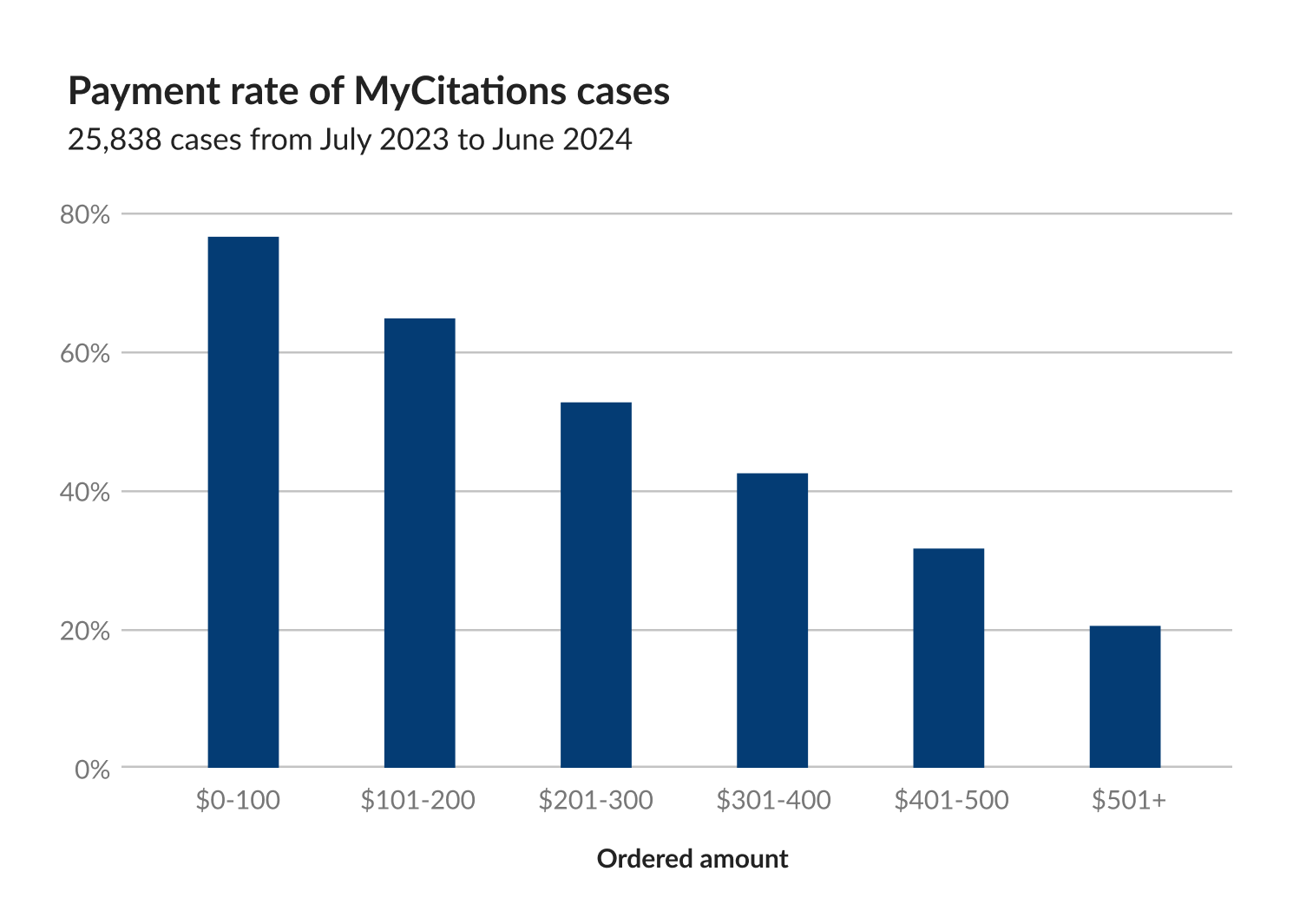
A clear relationship was visible: payment of fines and fees increases as the ordered amount decreases. When the ordered amount was $100 or less, more than 70 percent of cases were either fully repaid or projected to be when accounting for payment plans. When it exceeds $500, that rate drops to around 20 percent. The relationship is roughly linear: every $100 reduction in the ordered amount corresponds to about a 10 percentage-point increase in full payment.
This finding was consistent with similar studies made available in previous legislative reports.3
Notes
1Federal Register :: Annual Update of the HHS Poverty Guidelines
2California Code, GOV 68645.2.
3Reports to the Legislature | Judicial Branch of California
4The data represented in this dashboard is provided for informational purposes only. New requests are received daily and there will always be unprocessed requests that do not have final data to report.