Shortage of Court Reporters in California
Updated March 2026
Overview
Courts across California are facing a persistent shortage of court reporters. Courts rely on certified shorthand reporters (“court reporters”) to capture verbatim records of court proceedings in case types where electronic recordings are not authorized by statute.1 Since April 1, 2023, more than two million hearings in unlimited civil, family law, and probate proceedings have taken place without a verbatim record.2 California courts need an additional 458 full-time equivalent (FTE) court reporters to meet current caseload demands.3
Why does this matter?
The absence of a verbatim record makes it nearly impossible for individuals to appeal their case. The California Supreme Court has stated that the lack of a verbatim record will “frequently be fatal” to a litigant’s ability to have an appeal decided on the merits.4 The shortage of court reporters threatens access to justice, especially for Californians who cannot afford to pay for their own court reporter.
Summary
- The majority of family law, probate, and unlimited civil hearings lack a verbatim record.
- The court reporter shortage continues to undermine access to justice as the workforce remains critically below need.
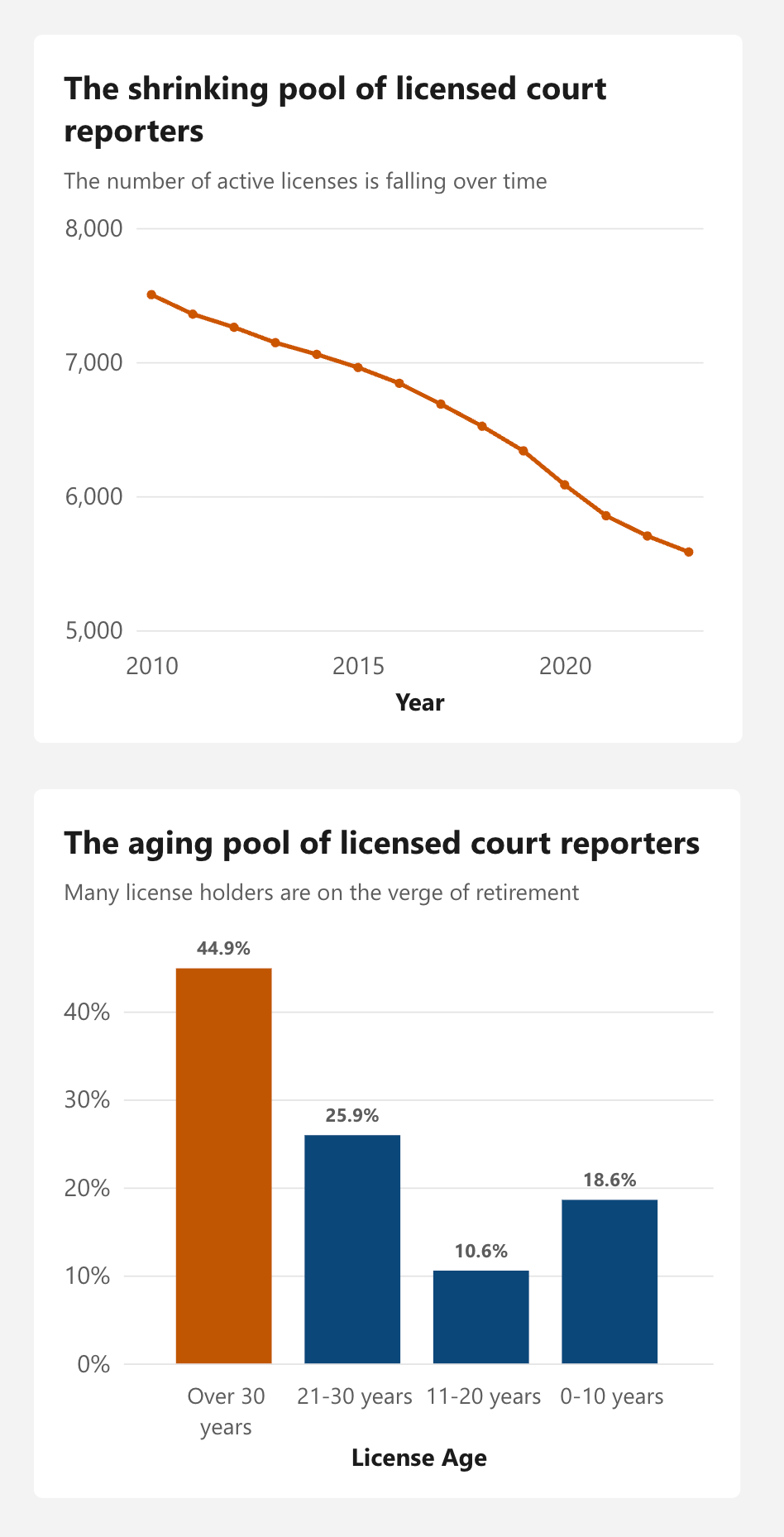
- The court reporter pipeline is under extreme strain as many near retirement and licensing lags.
- Courts face intense competition and rising costs in recruiting and retaining qualified court reporters.
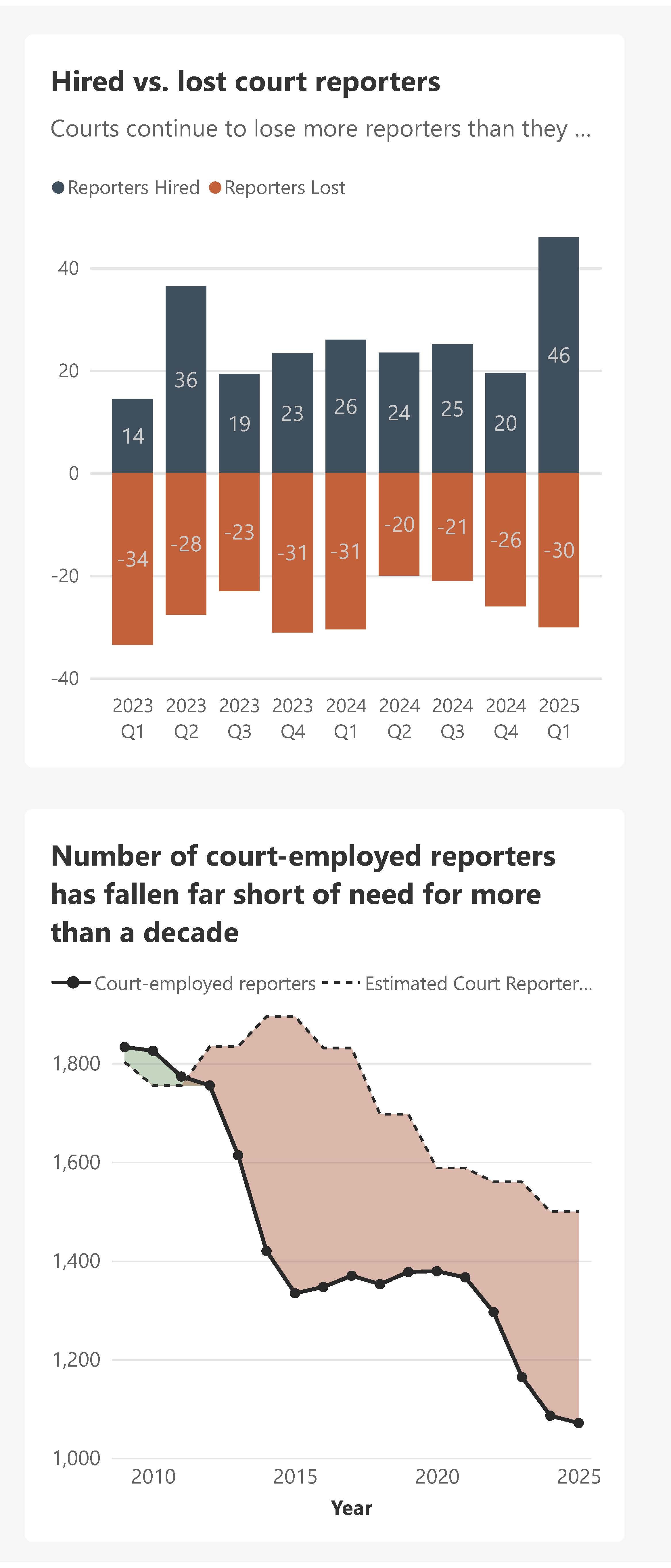
- Court reporter hiring shows promising gains but still falls short of meeting demand.
The majority of family law, probate, and unlimited civil hearings proceed without a verbatim record.
Out of 2,831,718 family law, probate, and unlimited civil hearings held between April 1, 2023, and June 30, 2025, approximately 2,032,277 (71.8 percent) had no verbatim record.2
The inability to create a verbatim record limits people’s ability to appeal significant and life-changing decisions regarding child custody, paternity, conservatorship assets, and more. This is a direct consequence of the court reporter shortage in California.
The court reporter shortage continues to undermine access to justice as the workforce remains critically below need.
California’s trial courts face a persistent and consequential shortage of court reporters. As of 2025, there were 1,070 court-employed reporters in California. To meet the demands of the current caseload,6 California courts need an additional 458 full-time court reporters.3 In recent surveys, California courts reported that between January 1, 2023, and June 30, 2025, 286.2 (FTE) court reporters were hired, of which 112.4 (FTE) were voice writers (39.3 percent of all hires).2 During this period, although 273.3 (FTE) court reporters left positions at the courts, there was a net gain of 12.9 (FTE) reporters employed across the branch.This marginal increase is insufficient to close the gap in providing verbatim records.
The consequences are stark: From April 1 to June 30, 2025, 255,334 out of 344,845 hearings in unlimited civil, family, and probate cases (74 percent) still occurred with no verbatim record. Without such records, litigants face significant barriers to appeal. This shortage continues to threaten access to justice.
California courts need at least 458 additional full-time court reporters to meet minimum requirements.
The court reporter pipeline is under extreme strain as many near retirement and licensing lags.
California’s court reporter workforce faces serious long-term stability challenges. As of March 4, 2026, 48.7 percent of active licenses were issued at least 30 years ago, signaling a heavy reliance on a shrinking pool of long-tenured professionals.7
At the same time, entry into the profession remains limited. In fiscal year (FY) 2024–25, only 227 new licenses were issued statewide.7, 8 Most candidates pursue licensure through court reporter schools, a process that typically takes three to four years. Success is not guaranteed; of the 308 applicants who attempted the skills (dictation) portion of the last three California Certified Shorthand Reporter exams, just 53.6 percent passed.9
The combination of limited new entrants and a workforce heavily composed of long-tenured license holders presents a growing risk to the continuity of verbatim recordkeeping in California’s courts.
Courts face intense competition and rising costs in recruiting and retaining qualified court reporters.
Court reporters in California courts are paid, on average, 51 percent more than other nonmanager court positions. At the same time, the declining number of court reporters in California has created a tight and competitive labor market, exacerbating compensation pressures.
The median total salary plus benefits for each court reporters is estimated to be $205,030.91.10 This is significantly lower than the cost to hire a court reporter through a private company: $2,580 per day for a deposition and $3,300/day for a trial, on average.11
Additionally, transcripts must be purchased from court reporters. In 2021, the Legislature increased the statutory transcript fees by approximately 30%.19 In FY 2024–25, California courts spent $25.2 million on transcripts.13
Court reporter hiring shows promising gains but still falls short of meeting demand.
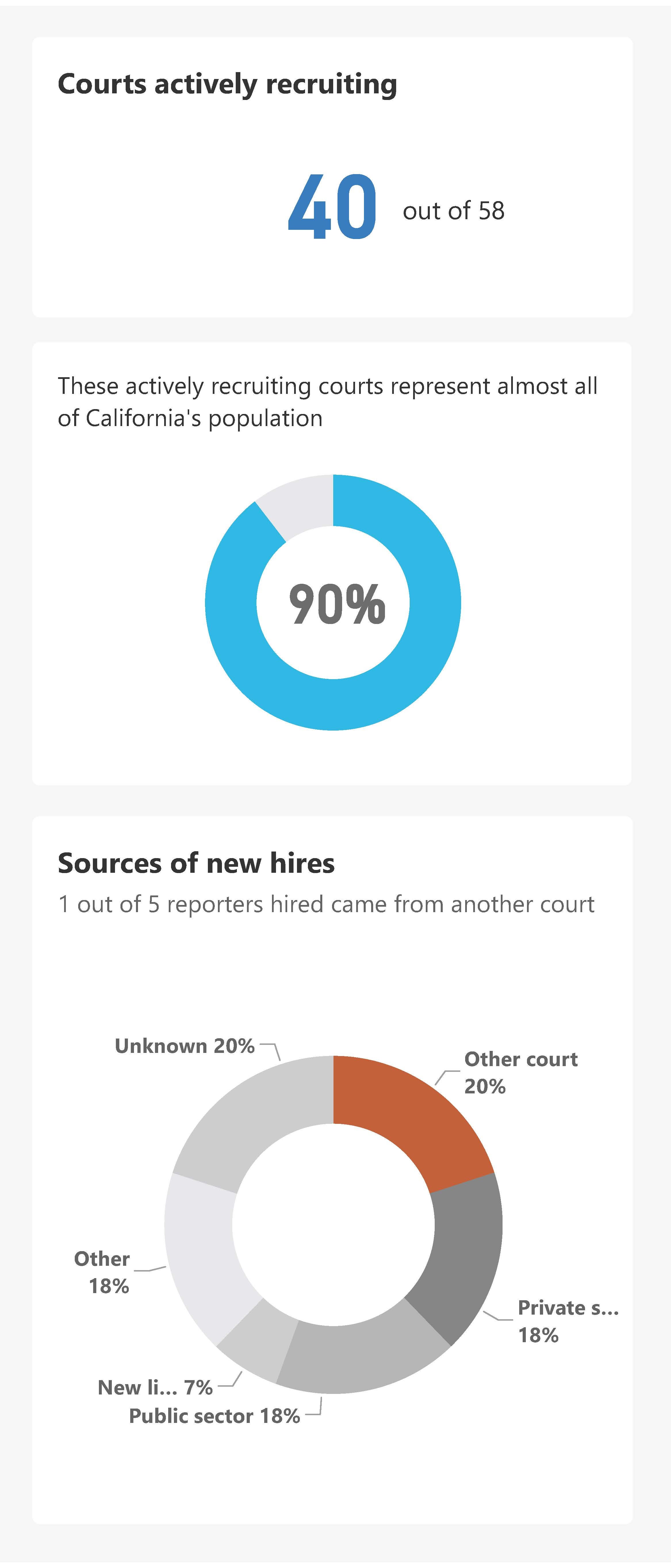
In 2025, courts began to see the benefits of offering incentives, resulting in two consecutive quarters of modest net gain in the state’s judicial branch court reporter workforce. Between January 1, 2023, and June 30, 2025, approximately 91.4 percent of trial courts have used at least one incentive to recruit and retain court reporters. These incentives include increased salary ranges (75.9 percent), retention and longevity bonuses (72.4 percent), signing bonuses (72.4 percent), finder’s fees (46.6 percent), and more.14
This growth will need to accelerate significantly to help close the court reporter gap and keep pace with retirement. While the court reporter shortage continues, authorizing the use of electronic recording to create a verbatim record for family law, probate, and unlimited civil proceedings would increase access to justice for millions of Californians.
Examples of incentives:
- The Superior Court of Riverside County offered up to $32,500 in retention payments over three years.
- The Superior Court of Contra Costa County provides a $12,000 tuition reimbursement fund for existing court employees to use toward pursuing court reporter certification.
- The Superior Court of San Francisco County created the first court reporter internship program in the nation.
- The Superior Court of Los Angeles County offered a signing bonus of up to $50,000 for newly hired court reporters, $15,000 student loan and equipment allowance, and $25,000 finder’s fee for court employees who refer a court reporter.15 In addition, the court has offered a program to its employees that includes a full court reporting tuition scholarship, the ability to attend classes during work hours, and guaranteed employment as a court reporter upon licensing.
Notes
1 Electronic recording is not authorized by statute except in limited civil, misdemeanor, and infraction proceedings when a court reporter is unavailable. (Gov. Code, § 69957(a).)
2 Reported in surveys completed by California trial courts since April 2023. Surveys asked trial courts to provide, among other information, the number of hearings without a verbatim record for unlimited civil, family, and probate case types; the number of total hearings for each of these case types individually; and the aggregate for these three case types without a verbatim record and the total number of hearings. In instances where a trial court did not provide either a number for unlimited civil, family law, and probate hearings without a verbatim record or a number of total hearings for one of those case types, that case type data was removed from the dataset. Prior to April 2023, reporting was not consistent.
3 “Need” is calculated in accordance with how the resource assessment study estimates court reporter need, by multiplying the assessed judicial need for each included case type by a factor of 1.25, except for civil unlimited and estates and trust, which are multiplied by a factor of 0.625. courts.ca.gov/news-reference/research-data/court-workload-analysis.
4 Jameson v. Desta (2018) 5 Cal.5th 594, 608.
5 California trial courts must also provide an official court reporter in civil cases when a party with a fee waiver requests one and the proceeding cannot otherwise be electronically recorded.
6 The “current caseload” covers all case types where a court reporter is required or electronic recording is not authorized.
7 Department of Consumer Affairs, Licensee List (March 2026), dca.ca.gov/consumers/public_info/index.shtml. Total includes delinquent licensees and those who reside out of state. Excluding them, 174 new licenses for FY 2024–25 remain.
8 Only 8 court reporting programs recognized by the Court Reporters Board of California remain open (down from 17 schools in 2010). For a list of recognized schools and the requirements they must meet, please see courtreportersboard.ca.gov/applicants/school_info.shtml. However, students may also qualify for California’s Certified Shorthand Reporter exam by obtaining national certification demonstrating proficiency in machine shorthand reporting or voice writing.
9 Court Reporters Board, School Examination Statistics, courtreportersboard.ca.gov/applicants/examstats.shtml. The last three dictation examination statistics published are from March, July, and November 2025.
10 Median value of estimated salary and benefit costs statewide by the filled court reporter FTEs, Schedule 7A.
11 Data provided by a survey of 49 private consumer attorneys. It is unknown how much of the court reporter rate charged by companies is provided to the reporter in the form of compensation and how much is kept by the company.
12 Sen. Bill 170 (Stats. 2021, ch. 240).
13 2024–25 Schedule 7A total court statewide transcript expenditures, excluding Electronic Recording.
14 Surveys completed by California trial courts.
15 Superior Court of California, Los Angeles County, Data Dashboard: Impact of Certified Court Reporter Shortage (Feb. 23, 2026), lacourt.ca.gov/pages/lp/research-and-statistics/tp/court-reporters/cp/data-dashboard-impact-of-certified-court-reporter-shortage.