
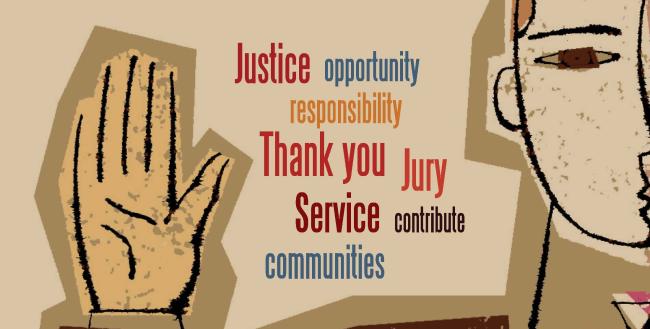
Juror Appreciation Week, May 11-15, 2026
In 1998, the California Legislature designated the second full week in May each year to honor the important contributions of citizens who devote their time and effort "making the cherished right of trial by jury a reality and to raise awareness about their contribution to our courts."
Each year, the Judicial Council and the superior courts team up to recognize the millions of Californians who answer the call to serve their communities and put into practice the fundamental American ideal of justice.
“Millions of Californians are called each year to fulfill their civic duty by reporting for jury service,” said Chief Justice Patricia Guerrero. “Jurors play a critical role in our justice system by ensuring everyone can take advantage of the fundamental right to a jury of their peers. Jurors help deliver that fundamental right and the promise of fair and equal access to justice for all Californians.”
Over the past several years, the judicial branch has continued working to improve the juror experience. This has meant leveraging new technology, implementing innovative pilot programs, and exploring changes to the jury service process. This is because without juries, our legal system would not be able to function. There is no replacement for the role jurors provide in our democracy and the impact they have on our society.
Why celebrate Juror Appreciation Week?
- To celebrate our jurors for their outstanding and important service;
- To recognize the sacrifices jurors make in order to fulfill their civic duty;
- To honor the relationship between jurors, courts, and their local communities; and
- To join with our justice partners and other courts in acknowledging and thanking jurors.
Why participate in jury service?
You have the opportunity:
- To make a difference in your local community by supporting fair trials
- By helping ensure access to justice for everyone, including yourself;
- To fundamentally contribute to our American system of law and order;
- To discover how empowering jury service can be, how treasured the connections you will make with others during the course of your service can be; and
- To directly affect an individual’s life by weighing evidence, taking part in a trial, and rendering a verdict.
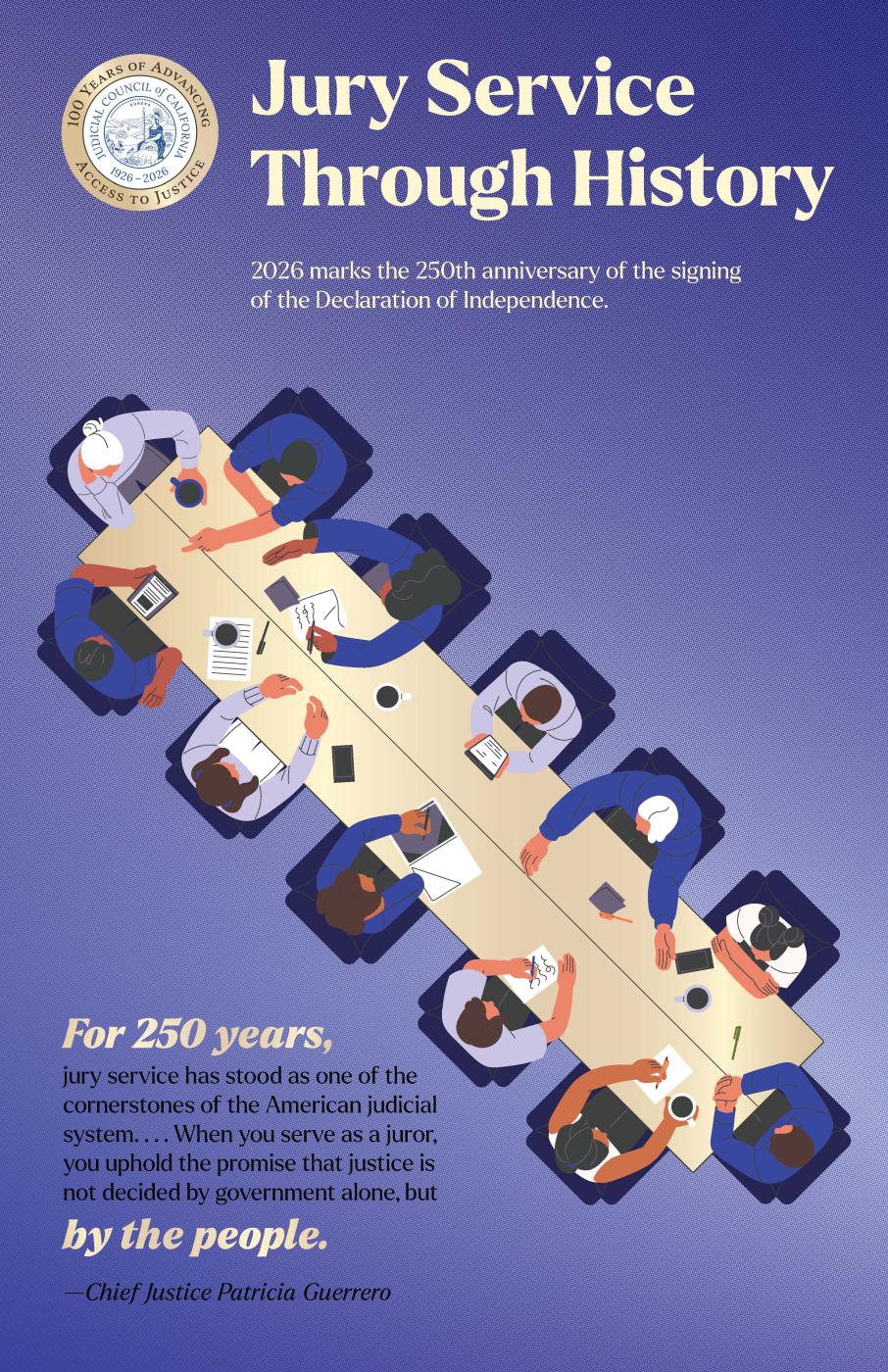
Did you know?
Statewide, Californians participate in jury service each year in the following ways:
- Over 10 million people are summoned, or 1 in 4 people statewide;
- More than 4.5 million people complete jury service, either in-person, on call, or standby;
- Approximately 100,000 are sworn in as trial jurors; and
- At least 70% of prospective jurors who arrive in person complete their service in one day.
As a group, jurors comprise the largest volume of participants in the legal system. Over the last 100 years, the judicial branch has continued to look for ways to improve the juror experience. For example:
- Recent legislation allows courts to reimburse jurors for up to $12 per day beginning on the first day of in-person service if they use public transit rather than a personal car. Courts are also now authorized to partner with public transit agencies to develop programs that improve access for jurors to mass transit in the court's jurisdiction.
- Courts are taking juror stress and trauma seriously by providing mental health information with links to county and state-level resources for individuals serving in “violent felony” cases. Learn more at our Juror Mental Health and Wellness landing page.
- The branch has three educational videos, including an updated juror orientation video.
- Justice For All: Jury Service, is being shown in courtrooms across the state. With a diverse cast of characters, the video provides jurors with the information they need to understand their role and responsibility, as well as basic facts about courtrooms and the trial process.
- A History of Jury Service: A More Perfect Juryprovides a history of jury service in the United States and in California more specifically, highlighting the ways in which courts have increased access to jury service for all citizens.
- Jury Service and Fairness: Understanding the Challenges of Implicit Biasserves as a guide and a tool for jurors to identify whether they may have preconception that would impact their ability to serve.
- The judicial branch has completed development of a platform to pay juror per diems using an e-payment platform through Zelle. Already hundreds of participants have used this option in lieu of receiving a paper check. This has shortened the time for jurors to get paid at the conclusion of their service, as well as reduced administrative costs for the branch.
- Some courts are now creating virtual public counters that allow jurors to log in through a court's website using Zoom rather than calling a standard telephone line or sending an email. Jurors can speak with a staff member, go over their jury service information, submit postponements and/or hardships, as well as get answers to any questions they may have about jury service.
- Courthouse construction continues across the state and one area that is receiving particular focus are jury assembly room facilities. Courts are offering more charging stations for personal electronic devices, improving WiFi options, making more comfortable chairs and quiet rooms available, as well as streaming educational videos for jurors while they are waiting to be assigned to a courtroom.
Public Resources
- To learn more about jury service, please read our Jury Handbook.
- To get information and instructions for responding to your juror summons, check out our Court and Community pamphlet.
- For more information about how juries reach a verdict, take a look at our reference Guide to Jury Deliberations.
- If you are currently serving or recently served as a juror and are having difficulty adjusting, you may want to review our Jury Service Stress guide.
- Employers and employees should read through our Better for Business pamphlet on how investing in jury service pays dividends for all of us.
- As technology continues to take an integral place in our daily life, our resource on Navigating Social Media and the Internet for Jurors can help ensure everyone is using it appropriately while completing their jury service.
- Focus on the Courtroom posters that are displayed in jury assembly rooms to remind jurors that inappropriate use of social media and the internet is prohibited during a trial. What jurors “tag” or “tweet” and who they “friend” could be grounds for a mistrial or an appeal, adding cost to taxpayers for a new trial and delaying justice for all of us.
- The Judicial Council has continued to develop ourplain language jury instructions in criminal and civil trials, and jurors can ask permission to question witnesses as well as take notes during trials.
- To get local your court’s web address and other contact information, please use the Find My Court option
- To get jury information from your court, use our website’s local jury information tool. Each court is responsible for the content on their website.
- Don’t forget to check out all our resources for the public, attorneys, court staff, and even judges on our website at the Jury Service page!
Jury Service & Other Games
- How much do you know about jury service? A crossword puzzle.
- What’s the first thing that comes to a juror’s mind? A wordsearch puzzle.
- Test your civics knowledge in this matching game.
- Take a ride on the Justice Express and explore the legal system in Court Quest, by iCivics.
- Check out the award-winning virtual jury service experience from Jury Games.
- Do you have what it takes to reach The Verdict? Try this interactive online drama from Logic Locks.
Jury News Fit to Print
- In Defense of Jury Duty, Tampa Bay Times
- The Enduring Promise of the Jury, The Carolina Journal
- What to Know About Federal Grand Juries, Pew Research Center
- Grand Jury Report Controversy Continues, The Plumas Sun
- Virtually the Same? A Comparison Between In-Person and Virtual Mock Jury Deliberations, American Psychological Association
- Jury Selection Begins in Landmark Trial on Social Media, ABC News
- On Its 250th Anniversary America Must Preserve Jury Trials, The Hill
*Please note that all third-party links are shared here for informational purposes only. The Judicial Council of California is not responsible for any third-party website and does not endorse its content.*